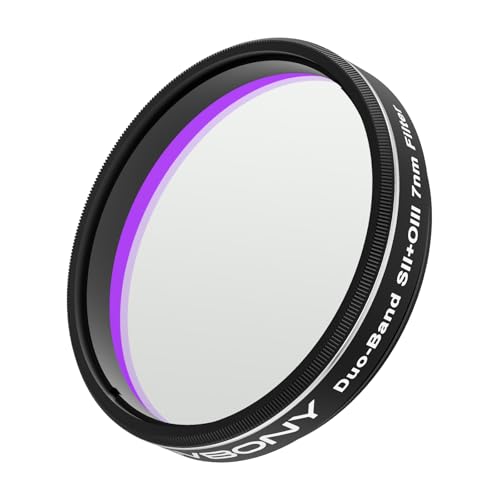
SVBONY SV220 Telescope Filter
Usually $87.49
Price checked today at 04:41 CT
Tired of light pollution washing out your deep-sky astrophotography?
Verified by Agora · Price and availability shown are accurate as of the date/time indicated and are subject to change. Any price information displayed at the time of purchase on Amazon will apply. As an Amazon Associate, Agora earns from qualifying purchases.
What we've verified about this price
Our read on this product
This filter is built for a very specific problem: capturing detailed deep-sky images when your local light pollution makes it nearly impossible. Its 7nm dual-band design isolates the SII and OIII emission lines, which are key for nebulae and similar objects, effectively cutting through the orange and white glow of city lights. This means you can get usable, high-contrast astrophotography data even if you're not in a perfectly dark sky location.
It's engineered to work with one-shot color cameras, simplifying your workflow by allowing you to capture these specific wavelengths in a single pass, rather than needing multiple filters and complex image stacking. The high transmission and sharp cut-off are crucial here, ensuring you capture the faint details of deep-sky objects without being overwhelmed by the surrounding light pollution. This isn't for casual stargazing; it's a tool for serious astrophotographers looking to push their imaging capabilities.
What makes it stand out
- Specifically targets SII and OIII emission lines, unlike broader light pollution filters that block a wider spectrum.
- Designed for one-shot color cameras to capture specific wavelengths in a single pass, simplifying the imaging process.
- Offers a 7nm dual-band design for high transmission and sharp cut-offs, crucial for revealing fine details in nebulae.
When this isn't the right fit
- This filter is not designed for visual observing, only for astrophotography.
- If you already have access to a truly dark sky site, the benefits of this specific filter may be less pronounced.
Real-world notes
- Even with this filter, some residual noise from light pollution might still be present, requiring careful post-processing.
- The 7nm bandwidth is very narrow, meaning it's highly specific to certain emission lines and may not be ideal for all types of deep-sky objects.
This filter is a confident pick for astrophotographers struggling with light pollution who use one-shot color cameras.
How this price compares over time
Not enough tracked price history yet.