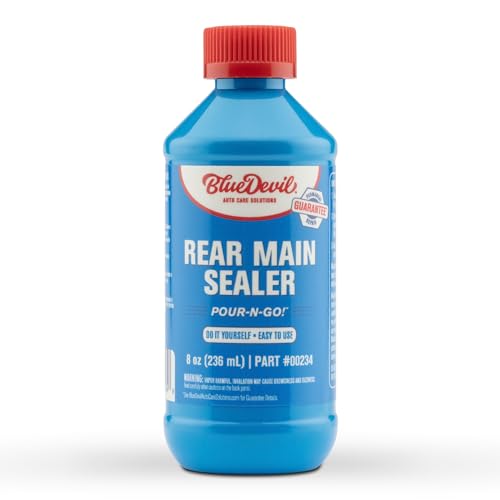
BlueDevil Products 00234 Rear Main Sealer
Usually $20.02
Price checked 9m ago
Facing a massive repair bill for a rear main seal leak often feels like the end of the road for an older car, but this chemical treatment offers a potential way to buy more time.
Verified by Agora · Product prices and availability are accurate as of the date/time indicated and are subject to change. Any price and availability information displayed on Amazon at the time of purchase will apply to the purchase of this product. As an Amazon Associate, Agora earns from qualifying purchases.Price checked 9m ago
Verified History
What we've verified about this price
Our read on this product
Replacing a rear main seal is a job that often costs more in labor than the vehicle is worth, as it requires separating the engine from the transmission. This additive offers a way to bypass that mechanical nightmare by chemically softening and expanding the rubber seal while the engine runs. It is a gamble, but one that many owners take when facing a four-figure repair bill for a drip that is more annoying than catastrophic.
You simply pour it into the oil reservoir and let the engine circulate the fluid. It does not contain particulates that could clog an oil filter, which is a common concern with older stop-leak formulas. If the seal is merely shrunken or hardened from age, you might see the leak slow or stop entirely within a few hundred miles of normal driving.
What makes it stand out
- Non-particulate formula avoids the risk of clogging oil passages or filters common with older, thicker stop-leak additives.
- Works on both gasoline and diesel engines, unlike many specialized sealants that are limited to one fuel type.
When this isn't the right fit
- The leak is caused by a torn or physically shredded seal, as chemical sealants cannot bridge large mechanical gaps.
- Your vehicle is under warranty, as using additives can sometimes complicate manufacturer coverage.
- You are dealing with a massive, active puddle of oil rather than a slow, persistent drip.
Real-world notes
- The results are rarely immediate, often requiring several days or hundreds of miles of driving to take effect.
- It does not need to be added again after an oil change, as the seal restoration is intended to be permanent.
Use this as a final attempt to extend the life of an older vehicle before committing to a major mechanical overhaul.